



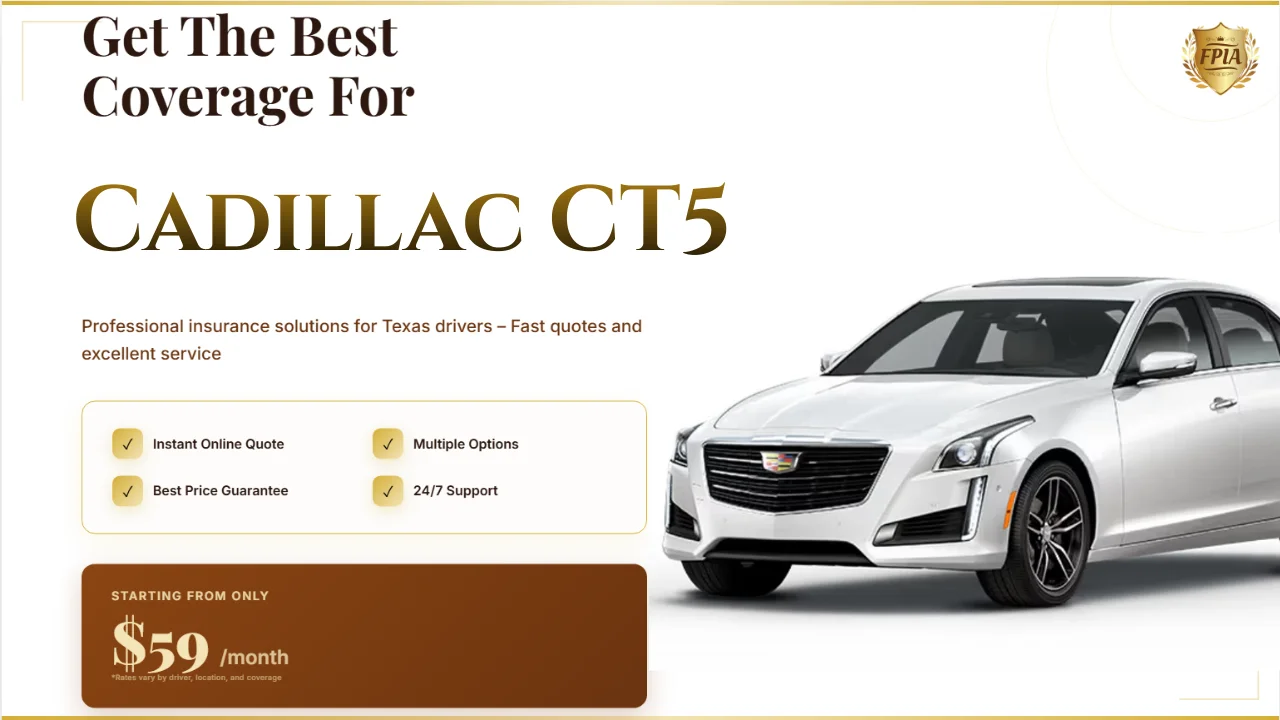
Best Cadillac CT5 Insurance in Texas: Get Instant Quote
Published: January 28, 2026
Meet Sarah, a marketing director living in Austin. She recently traded in her sedan for a sleek, new Cadillac CT5, drawn in by its sharp styling and the promise of a comfortable, tech-filled commute. When her old insurance provider sent the renewal notice, she just clicked "accept" without a second thought. Then, a freak hailstorm swept through the city. The damage to her CT5's roof and hood was extensive. That's when Sarah discovered her first mistake: her policy had a $1,000 deductible for comprehensive claims. The second shock came when the repair shop mentioned they would use aftermarket parts unless her policy specified otherwise. Sarah's story is a textbook example of how CT5 owners in Texas, from Houston to Dallas, make well-intentioned but costly insurance errors. This guide is for you if, like Sarah, you want to protect your investment without learning the hard way. We'll expose the common pitfalls and show you how to secure the best Cadillac CT5 insurance in Texas.

Mistake #1: The "Set It and Forget It" Policy Renewal
Like Sarah, many CT5 owners make the critical error of passively renewing their existing policy without a review. This is dangerous for two Texas-specific reasons. First, your vehicle's value changes. Your CT5 depreciates, which can affect your premium and the gap between what you owe and what it's worth. Renewing without considering Gap insurance on a new or financed vehicle is a risk. Second, your life circumstances change. Did your commute get shorter? Did you install a new security system? These can qualify for discounts you're missing. Third, the Texas insurance market changes constantly In an effort to keep the monthly payment low, many CT5 owners select high deductibles—often $1,000 or more—for their comprehensive and collision coverage. In Texas, this is a calculated gamble with poor odds. Let's break down why. Comprehensive claims are frequent in Texas. Hail, windstorm debris, animal strikes, and vandalism are common. A $1,000 deductible means you pay the first $1,000 of any such repair. Given that a single hailstorm can cause $3,000+ in damage to a CT5's body panels and glass, you're setting yourself up for a major out-of-pocket expense for a claim that wasn't your fault. The premium savings from a high deductible are often minimal (sometimes just $10-$20 per month) compared to the financial hit when you need to use your coverage. The mistake is viewing insurance only as a monthly cost, not as a risk transfer mechanism for likely events. This is the mistake that affects the long-term value and safety of your Cadillac CT5. The vast majority of standard insurance policies have a clause that allows the use of aftermarket or non-original equipment manufacturer (non-OEM) parts for repairs. For a vehicle like the CT5 with integrated safety sensors, advanced driver-assist features, and specific performance characteristics, non-OEM parts can be a disaster. They may not fit precisely, which can affect aerodynamics and safety. More critically, they may not interface correctly with the vehicle's computer systems, potentially disabling features like automatic emergency braking or lane-keep assist. The mistake is not requesting an OEM parts endorsement or failing to confirm your chosen insurer defaults to OEM parts for vehicles under a certain age. This endorsement ensures your CT5 is repaired with genuine Cadillac parts, preserving its integrity, warranty, and resale value. This mistake is about what happens when someone else hits you. Texas consistently has one of the highest rates of uninsured drivers in the nation. If you're hit by an uninsured or underinsured driver, your own policy's Uninsured/Underinsured Motorist (UM/UIM) coverage is what pays for your CT5's repairs and your medical bills. The critical error here is accepting the state minimum UM/UIM limits or waiving the coverage entirely to save a few dollars. Given the statistical probability of encountering an uninsured driver on Texas roads, this is one of the most financially reckless decisions you can make. Robust UM/UIM coverage is not an optional add-on in Texas; it is a fundamental layer of protection for your vehicle and your health. Correcting these mistakes requires a proactive, informed approach. Follow this checklist to build a robust policy. Commit to getting at least two competitive quotes from different sources (including one independent Texas agent) before each renewal. This keeps your rate honest and your coverage modern. Opt for a lower comprehensive deductible ($250 or $500) to mitigate Texas weather risks. You can consider a slightly higher collision deductible if you have a strong emergency fund, but never skimp on comprehensive. When getting quotes, explicitly ask: "Does this policy guarantee the use of genuine Cadillac (OEM) parts for repairs on my current model year vehicle?" Get the answer in writing or as a formal endorsement. Set your Uninsured/Underinsured Motorist bodily injury and property damage limits to match your high liability limits (e.g., 100/300/100). This is your financial shield. If your CT5 is new or you owe more than its current value, Gap coverage is essential. It pays the difference between the insurance settlement and your loan balance if the car is totaled. You won't fix these mistakes by using a faceless online quote engine. The solution is to partner with a Texas-licensed independent insurance agency. These agents work for you, not a single insurance company. They have access to multiple "A"-rated carriers and can explain the nuances of OEM endorsements, Texas-specific deductibles, and UM/UIM coverage in plain English. They act as your advocate, helping you avoid the very mistakes Sarah and so many others make. They understand the local risks in your city and can tailor a policy accordingly. Build Your Mistake-Proof Cadillac CT5 Insurance Policy in Texas Here Take control of your CT5's protection today. Review your current policy against the four common mistakes listed. Then, reach out to a knowledgeable Texas agent for a review and a competitive quote. A small investment of time now can prevent a massive financial and logistical headache later. The mistakes are similar, but the stakes are higher. The V-Series' performance and higher value mean repair costs are greater, making OEM parts and adequate liability limits even more critical. Insurers also view high-performance models as higher risk, so shopping around is even more important to find a company that specializes in or favorably rates performance sedans. While some fixes (like lowering your deductible) may cost a bit more, others (like shopping at renewal) can save you hundreds per year. The real "savings" is avoiding thousands in out-of-pocket costs from a high deductible or an uncovered claim. It's about value and risk mitigation, not just premium price. Yes, significantly. Always inform your insurer if you park in a locked, private garage. It reduces the risk of theft, vandalism, and weather damage, which can lead to a lower comprehensive premium. It's a simple detail that is often overlooked when applying. Ask: "Can you walk me through exactly how this policy would respond if my CT5 was damaged by hail in Dallas or hit by an uninsured driver in Houston?" Their answer will reveal their understanding of Texas risks and the policy's practical application.
Mistake #2: Prioritizing Premium Over Protection (The Deductible Trap)

Mistake #3: Overlooking the "Parts" Clause in Your Policy
Mistake #4: Ignoring the Texas Uninsured Driver Epidemic

The Correction: How to Build a Mistake-Proof CT5 Policy in Texas
1. Shop and Compare at Every Renewal
2. Choose Smart Deductibles
3. Insist on an OEM Parts Guarantee
4. Maximize Your UM/UIM Coverage
5. Consider Gap Insurance (If Financed/Leased)
Where to Find This Intelligent Coverage in Texas
Don't Wait for a Hailstorm to Reveal Your Mistakes
Cadillac CT5 Texas Insurance: Persona-Focused FAQ
I have a CT5-V. Are my mistakes the same?
How much can I realistically save by fixing these mistakes?
Does parking my CT5 in a garage in Texas help?
What's the one question I should ask any agent when getting a quote?