


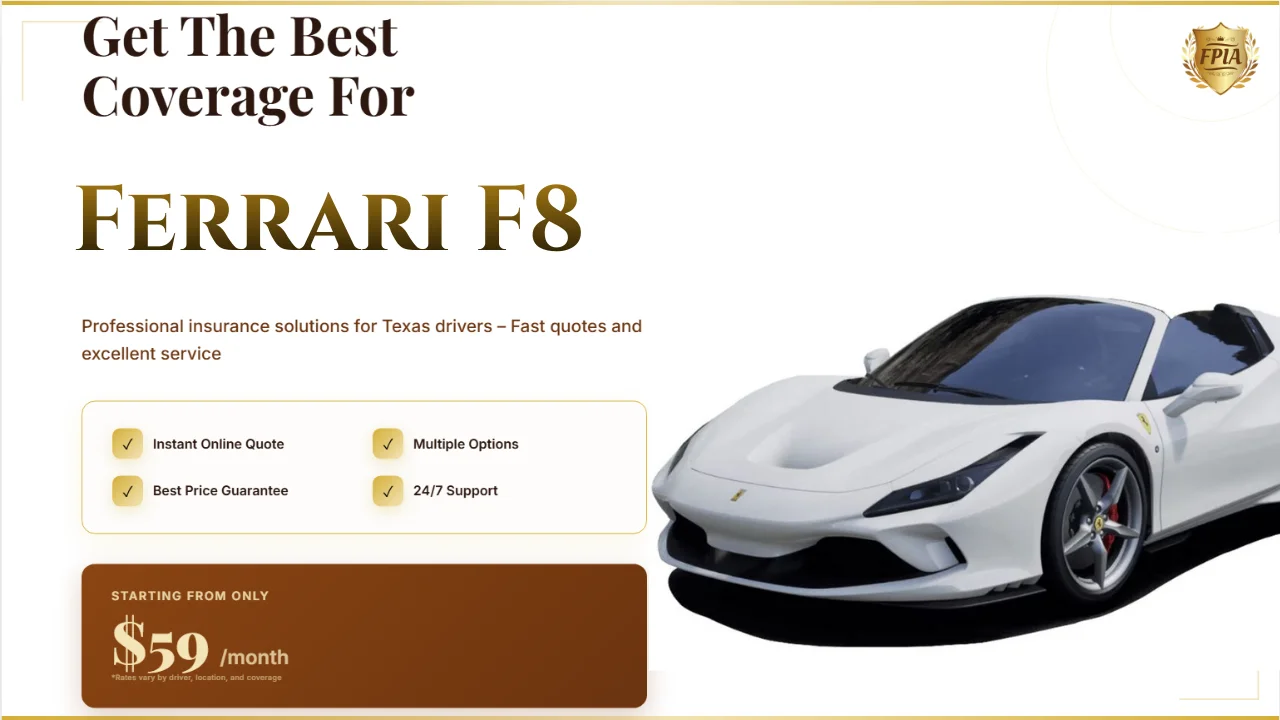
Best Ferrari F8 Insurance in Texas: Get Instant Quote
Published: January 28, 2026
Mark, a tech founder in Austin, had just fulfilled a lifelong dream: taking delivery of a Rosso Corsa Ferrari F8 Tributo. The car was everything he'd imagined—a blend of explosive performance and stunning design. But when he tried to add it to his existing insurance policy, the quote was so high it felt like a punch to the gut, and the coverage details were vague. Confused, he started searching online, only to be bombarded with generic ads and conflicting advice. Mark's story is a common one. Insuring a cutting-edge machine like the Ferrari F8 in Texas requires navigating a maze of options. This comparative review breaks down the paths available to owners like Mark, helping you make an informed choice to protect your six-figure investment.

The Unique Insurance Landscape for the Ferrari F8 in Texas
Mark quickly learned that his F8 isn't just another fast car. Its mid-engine, twin-turbo setup and extensive use of carbon fiber place it in the highest echelon of performance and repair complexity. Texas adds layers of difficulty. First, the state's notorious hailstorms pose an existential threat to the F8's delicate bodywork and glass. Second, the high rate of uninsured drivers means that even a not-at-fault accident could become a financial nightmare if the at-fault party has no coverage. Third, the scarcity of Ferrari-certified repair centers in Texas means even a minor incident could require an expensive, cross-state enclosed transport. These factors make standard insurance approaches not just inadequate, but financially dangerous for a vehicle of this caliber.

Comparative Review: Mainstream vs. Specialty Insurance for Your F8
Mark's research revealed two fundamentally different insurance philosophies. Understanding their core differences is critical to choosing the right protection.
Option 1: Mainstream National Insurance Carriers
These are the household names you see advertised everywhere. For an F8, their model shows significant cracks. They typically rely on Actual Cash Value (ACV) settlements, which factor in depreciation. Given the F8's strong value retention, an ACV payout after a total loss could leave you tens of thousands short. Their claims networks may push for aftermarket or "alternative" parts, which don't exist for an F8's unique components, leading to disputes and potential use of non-OEM parts. Their policies are built for volume, not nuance, and often contain broad exclusions for "competitive driving" or "track events," which can be interpreted loosely. While they might offer a policy, it's a generic solution for a highly specific problem.
Option 2: Specialty Exotic & High-Value Insurance Providers
This category includes insurers like Chubb Private Client, AIG Private Client Group, and specialty divisions of others accessed through expert brokers. Their approach is the antithesis of mainstream. They specialize in Agreed Value coverage, where the car's insured value is contractually set based on an appraisal. They insist on OEM parts and have claims adjusters who understand exotic car logistics. Their policies are designed for low-mileage, pleasure-use vehicles stored in secure garages. While the premium may be higher, the coverage is precise, comprehensive, and designed to make you whole without argument. For a Texas-based F8, this path aligns the coverage with the actual risk and value of the asset.

Option 3: Hybrid "Collector Car" Insurers (A Conditional Fit)
Companies like Hagerty or Grundy market to collector car enthusiasts. For an F8, this can be a viable option only if your usage is extremely limited (typically under 2,500-5,000 miles per year) and the car is not a daily driver. They offer agreed value and understand classic/exotic cars, but their policies come with strict usage restrictions. If you plan to drive your F8 more frequently or for any commercial purpose, you will not qualify. For the right owner, this can be a cost-effective solution, but it is not a one-size-fits-all answer.
Key Rating Factors That Will Determine Your F8 Premium
Regardless of the path, insurers will evaluate your risk based on several key factors. Understanding these allows you to present your case in the best light:
- Agreed Value: The single largest factor. A professional appraisal sets this baseline.
- Annual Mileage: Perhaps the most critical behavioral factor. Staying under 5,000 miles per year can dramatically reduce premiums with specialty insurers.
- Garaging Location (ZIP Code): This pulls in local theft, hail, and accident statistics. A garage in a low-crime suburb is far better than street parking in a major city center.
- Driver Profile: Your age, driving record (especially tickets or at-fault accidents in the last 3-5 years), and sometimes even credit history are heavily weighted.
- Coverage Choices: Your selected deductible (a higher collision deductible can lower premium, but increases out-of-pocket cost in a claim) and the level of liability/UM coverage you choose.
How to Find and Vet a Reputable Insurance Provider in Texas
Mark's breakthrough came when he stopped looking for quotes and started looking for a partner. He sought an independent insurance agency in Texas with a dedicated high-net-worth or exotic car practice. Here’s the checklist he used:
- Proven Exotic Car Experience: Do they readily provide examples of placing coverage for other Ferrari or similar exotic owners?
- Access to Top Markets: Can they name the specific specialty carriers (like Chubb, AIG, etc.) they represent? Avoid agents who only quote standard markets.
- Consultative Approach: Do they ask detailed questions about your garage, mileage, and driving habits, or just ask for your VIN and driver's license number?
- Claims Advocacy: What is their process for assisting clients during a claim? This is when you need an advocate most.
- Texas Department of Insurance License: Always verify their license is active and in good standing.
A true specialist acts as your risk manager, not just a policy seller.
[Compare Your Ferrari F8 Insurance Options with a Texas Specialist]
Secure the Right Protection for Your Passion
Don't let the complexity of insuring a masterpiece like the Ferrari F8 lead to a costly compromise. Follow Mark's journey: understand the limitations of standard insurance, compare the specialized alternatives, and partner with an expert who can architect a policy worthy of your vehicle. The right coverage isn't an expense; it's an essential part of your ownership experience.
FAQ: Ferrari F8 Insurance in Texas
Is the F8 Tributo more expensive to insure than the 488 GTB it replaced?
Often, yes, but marginally. The F8's increased performance and newer technology can place it in a slightly higher risk category. However, the primary cost drivers (value, driver profile, location) are the same. The difference is usually less significant than the difference between a standard and a specialty policy.
Do I need a separate policy if I install aftermarket carbon fiber parts?
Yes. Any significant modification that increases the car's value or changes its performance must be disclosed. You may need to schedule these items or adjust your agreed value to ensure they are covered. Failure to disclose can lead to a claim denial.
How does the F8's advanced driver aids (like Side Slip Control) affect my rate?
While these features enhance safety, they are generally expected on modern exotics and do not typically generate specific discounts in the specialty insurance market. Their primary benefit is in potentially preventing claims, which helps maintain your clean driving record—a major rating factor.
Can I get temporary coverage for a long road trip from Texas to California?
Most standard and specialty policies provide coverage throughout the contiguous United States. However, you must confirm there are no territorial restrictions in your policy. For an F8, it's also critical that your roadside assistance includes nationwide towing to a Ferrari specialist, not just any repair shop.