


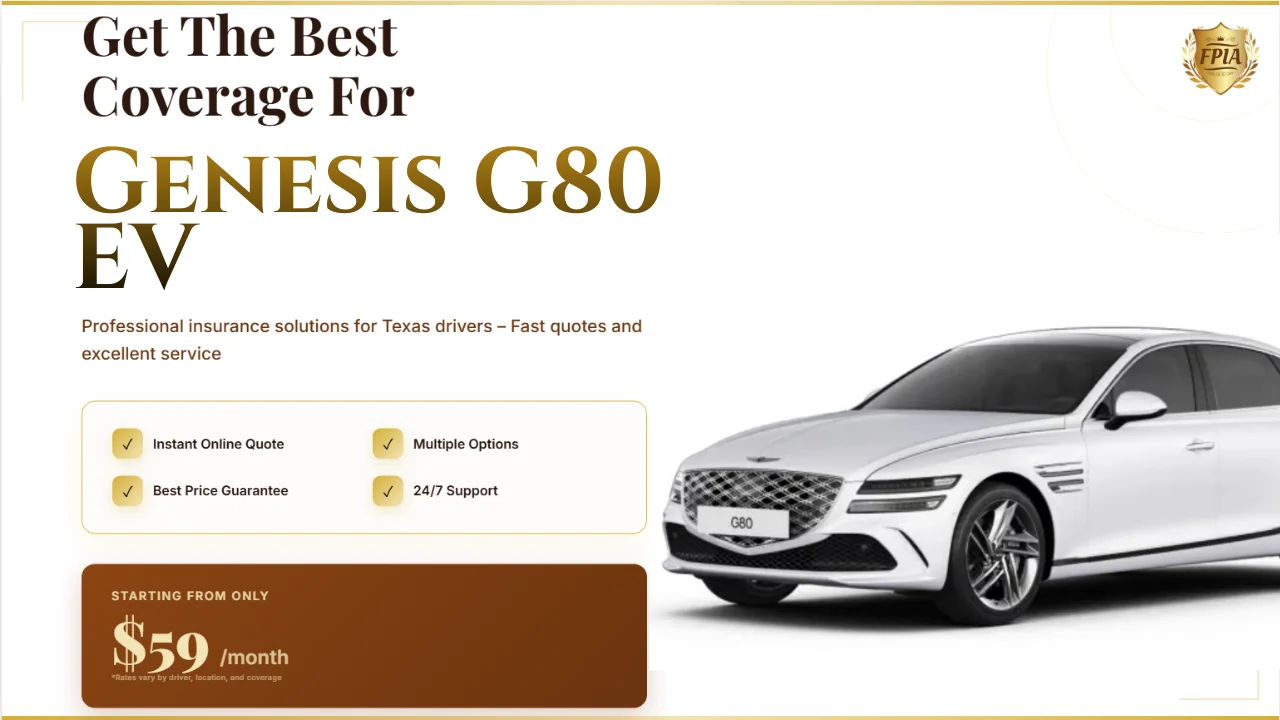
Best Genesis G80 EV Insurance in Texas: Get Instant Quote
Published: January 28, 2026
Imagine Sarah, a tech executive in Austin who prides herself on making forward-thinking choices. When she swapped her gas-powered luxury sedan for a Genesis G80 EV, it felt like the perfect alignment of her values and lifestyle. The silent, powerful drive through the Texas Hill Country was exhilarating. When her insurance renewal came up, she simply updated her vehicle type with her existing provider, assuming "electric" was just another trim level. Then, during a summer trip to Dallas, a sudden and violent hailstorm pummeled her parked G80 EV, damaging the panoramic glass roof, the intricate LED lighting, and leaving dozens of dents in the aluminum body. The repair estimate was staggering, but the real shock came next: her insurer argued that the battery pack's diagnostic system needed inspection at an additional, non-covered cost, and her policy's rental car allowance was for a compact gas car—not a comparable EV. Sarah's story is a wake-up call for every Texas EV adopter: insuring an electric Genesis G80 with a gasoline-era insurance mindset is one of the most expensive mistakes you can make. The gaps aren't just about cost; they're about coverage for technology that traditional policies were never built to understand.

Mistake #1: Assuming Your Standard Policy Covers the Battery & Tech Properly
Sarah's first, and most critical, error was assuming her existing "full coverage" automatically extended to the G80 EV's most valuable component: the high-voltage battery pack. While comprehensive and collision coverage typically apply to the battery if damaged in an accident or by hail, the devil is in the details. Many standard policies have sub-limits or vague language regarding diagnostic testing, calibration, and potential degradation after an incident. For example, if the battery casing is slightly compromised in a collision, the entire pack might need replacement—a cost that can exceed $20,000. If your policy isn't explicit, you could face a brutal fight over what's covered. Furthermore, the suite of sensors for Highway Driving Assist II and the 3D digital instrument cluster are astronomically expensive to repair or replace. A policy without an OEM (Original Equipment Manufacturer) Parts Endorsement might allow aftermarket imitations that can't communicate properly with the car's systems, crippling its functionality and safety.

Mistake #2: Ignoring the Texas-Specific "EV Penalty" in Risk Assessment
Texas presents unique, elevated risks that are magnified for an EV like the G80. First, hail and flood damage are not just bodywork issues. Hail can crack the large glass roof and damage embedded sensors. Flood water can irreparably harm the battery and motor control units, leading to an instant total loss. A standard policy with a high comprehensive deductible makes you bear the brunt of these frequent Texas perils. Second, the state's extreme heat can theoretically affect battery longevity and performance, which some insurers may indirectly factor into risk models. Third, and most importantly, Texas' leading rate of uninsured drivers (over 20%) is a direct threat. If an uninsured motorist hits your G80 EV, you rely on your own Uninsured/Underinsured Motorist (UM/UIM) coverage. Skimping on these limits or forgoing them entirely, as many do, leaves you paying for someone else's irresponsibility.
Mistake #3: Failing to Secure Adequate "Convenience" Coverages for an EV
Sarah's ordeal with the rental car highlights a third common oversight. EVs require specific planning, especially in Texas where charging infrastructure varies. Standard policies offer rental reimbursement for a basic car. But after your G80 EV is in the shop, you need a comparable vehicle. This means either another luxury EV or a vehicle you're comfortable with for a potentially long repair period (EV repairs can take longer due to parts and expertise). Furthermore, you should have robust roadside assistance that specifically covers EV-related issues, like a dead battery or running out of charge far from a station, not just flat tires and lockouts. Many owners also forget that their home charging equipment, a costly investment, needs protection under their homeowners policy, not their auto policy. This fragmented approach creates gaps in your overall risk management.
Mistake #4: Not Shopping with an Agent Who Understands EV Nuances
The final, and perhaps most decisive, mistake is using the same shopping channels for an EV. Getting an online quote from a generic comparison site or sticking with your old agent who's never insured an EV is a recipe for an inadequate policy. These channels rely on algorithms that may not be updated for the G80 EV's specific repair costs, battery valuation, or safety technology discounts. They cannot advise you on the critical endorsements you need. You need an agent who can answer questions like: "Does this policy have any exclusions for battery damage from road debris?" or "Which of your carriers has direct repair relationships with Genesis-certified EV repair shops in Texas?" Without this expertise, you're buying a product blindfolded.
The Corrective Blueprint: Insuring Your Genesis G80 EV the Right Way in Texas
To avoid Sarah's headaches, you must build a new policy from the ground up, tailored for an EV in Texas.
Step 1: Mandate Explicit Battery & Tech Coverage
Your policy must explicitly state that the high-voltage battery, electric motors, and charging port are covered under comprehensive and collision without punitive sub-limits. An OEM Parts Endorsement is non-negotiable to preserve the vehicle's integrity and safety systems.
Step 2: Fortify Against Texas Risks
Choose a comprehensive deductible you can afford after a hailstorm ($500 is wise). Set liability limits at a minimum of 250/500/250. Crucially, set your UM/UIM limits to match. This is your financial shield against Texas' uninsured drivers.
Step 3: Demand EV-Competent Convenience Coverages
Secure rental reimbursement for a luxury/EV-class vehicle for at least 30 days. Ensure your roadside assistance plan includes EV-specific towing (flatbed required) and charge-related service.
Step 4: Partner with a Texas Independent Insurance Agency
This is the keystone. A local independent agent doesn't work for one company; they work for you. They have access to carriers that are competitively pricing EVs and understand the needed coverages. They will shop your G80 EV profile across their network, provide expert guidance, and most importantly, be your advocate when you have a complex claim involving advanced technology.

The Essential Partner: A Texas Agent Who Speaks "EV"
The solution to all these mistakes is a single, powerful action: engaging a Texas-based independent insurance agency with experience in electric vehicles. This agent acts as your personal risk manager. They understand that insuring an G80 EV isn't just about the car; it's about the integrated technology and unique usage patterns. They know which insurers in Texas have favorable loss histories with EVs, which ones offer discounts for advanced safety tech, and which have efficient claims processes for battery-related incidents. When you have a claim, your agent becomes your translator and advocate, dealing with adjusters who may not understand EV intricacies and ensuring repairs are handled at qualified facilities. For a cutting-edge vehicle in a state with traditional risks, this partnership is not a luxury—it's a necessity for seamless protection.
[Get Your Tailored Genesis G80 EV Insurance Quote in Texas Now]
Protect Your Electric Investment with Precision
Your Genesis G80 EV represents the pinnacle of modern luxury and technology. Don't undermine its sophistication with an outdated, generic insurance policy. Learn from the common pitfalls, demand precise coverage, and secure your vehicle through a local expert who understands the future of driving in Texas. Drive electric, but insure with intelligent, tailored protection.
FAQ: Genesis G80 EV Insurance in Texas
Is the Genesis G80 EV more expensive to insure than the gas model?
Typically, yes. The higher initial cost, expensive battery pack, and specialized repair requirements for the EV model generally lead to higher premiums than the internal combustion engine G80. However, discounts for safety features and potential energy efficiency can help offset some of the difference.
Does my home insurance cover my home charging station?
It can, but you must check. The permanently installed charging equipment may be covered under your homeowners policy for perils like fire, theft, or weather damage. However, you should verify that your policy has sufficient coverage limits and no exclusions for EV charging equipment. Liability if someone is injured by your charger would also fall under homeowners liability.
What happens if I run out of charge on a Texas highway?
This is where proper roadside assistance is key. Many EV manufacturers include complimentary roadside assistance, and you can also add it to your auto policy. Ensure the service includes flatbed towing to the nearest charger, as dragging an EV with its wheels on the ground can damage the motors.
Why is an independent agent better for an EV than a direct online quote?
An independent agent provides expertise and advocacy that an algorithm cannot. They can explain the nuanced coverage needs of an EV, identify which carriers are most EV-friendly in the Texas market, and personally advocate for you during a complex claim involving advanced technology. They ensure you're not just buying a price, but a properly engineered protection plan.