


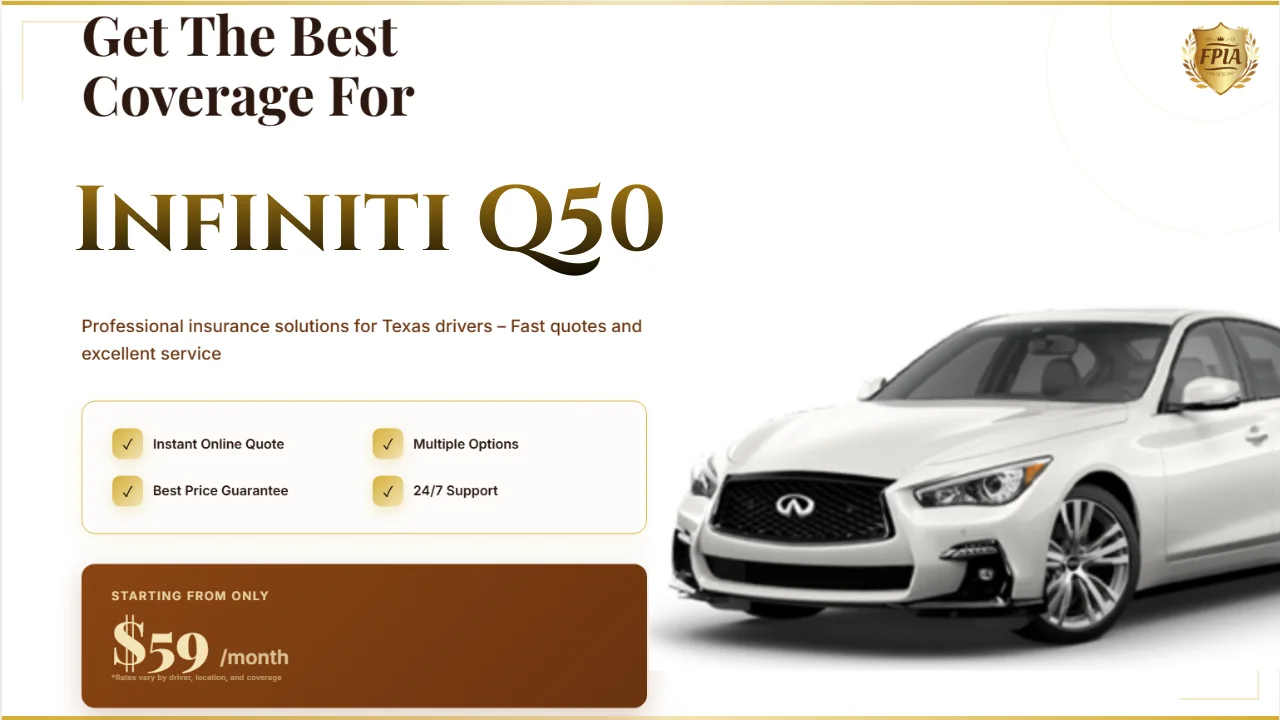
Best Infiniti Q50 Insurance in Texas: Get Instant Quote
Published: January 28, 2026
According to data from the Texas Department of Transportation, there were over 15,000 serious injury crashes and more than 4,000 fatalities on Texas roads in a recent year. For an Infiniti Q50 owner, these aren't just statistics; they represent a tangible financial risk that extends far beyond the vehicle's sticker price. The average cost of a bodily injury liability claim nationally now exceeds $24,000, and property damage claims average over $5,000—figures that dwarf Texas' minimum liability requirements. When you factor in the Q50's status as a luxury sports sedan with an average MSRP of over $45,000 and repair costs that are approximately 15-20% higher than non-luxury counterparts, the standard insurance approach becomes a significant liability. The core problem is that most Q50 insurance policies are priced on generic risk models that fail to account for the vehicle's specific repair complexity, its advanced safety technology's true loss-mitigation value, and the hyper-localized risk factors of your Texas ZIP code. This data disconnect leads to owners either overpaying for inadequate coverage or underinsuring a significant asset against Texas-sized perils.

The Data Behind the Risk: Why Q50 Insurance Demands Precision
Quantifying the risk profile of an Infiniti Q50 in Texas reveals three critical data points that standard insurers often gloss over. First, repair and parts cost inflation. The Q50's aluminum body panels, sophisticated Direct Adaptive Steering system, and advanced technology suite (like the InTouch infotainment system) require specialized tools and training for proper repair. Data from collision repair networks indicates that repair costs for luxury vehicles like the Q50 can be 50-75% higher for seemingly similar damage compared to mass-market sedans. Second, theft and partial loss statistics. While not the most stolen vehicle, luxury sedans are targeted for high-value parts. Comprehensive coverage must be robust. Third, and most critical for Texas, is geographic loss cost variance. Insurance rating algorithms assign different costs based on ZIP code. Urban centers like Houston (Harris County) and Dallas (Dallas County) have significantly higher frequencies of collisions, comprehensive claims (theft, vandalism), and liability claims than rural counties. Your premium is fundamentally tied to this geographic data.
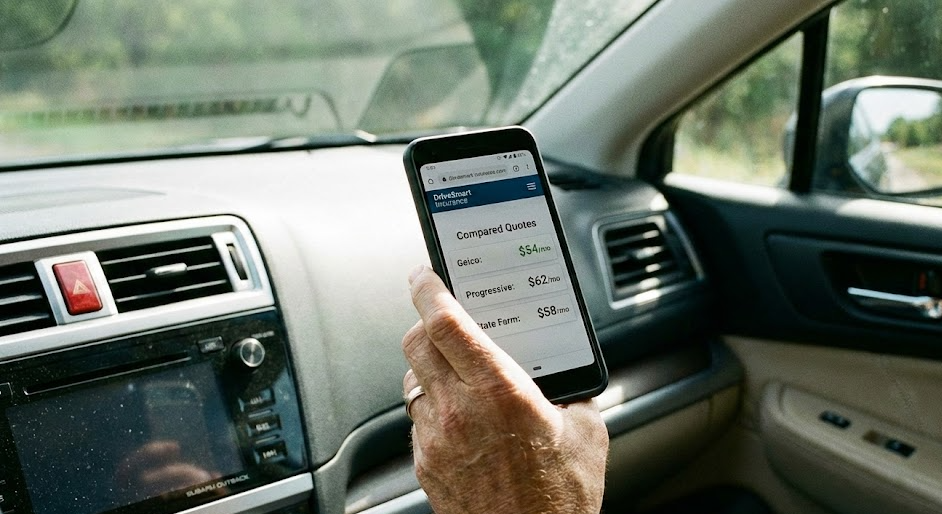
The High Cost of Inadequate Coverage: A Financial Exposure Analysis
Choosing a policy based solely on premium cost, without a data-driven coverage analysis, creates severe financial exposure. The most common and costly gaps are found in liability and physical damage coverage. Texas state minimum liability limits of 30/60/25 represent a coverage deficit of over 300% compared to the recommended 100/300/100 limits for a Q50 owner. In a multi-vehicle accident where you are at fault, medical bills and vehicle repair costs for others can easily exceed $100,000 per person, leaving you personally liable for the difference. Furthermore, opting for a high deductible (e.g., $2,500) to lower the premium creates a cash flow risk; data shows the average driver files a claim once every 17.9 years, but when they do, a high out-of-pocket cost can be burdensome. Finally, foregoing Uninsured/Underinsured Motorist (UM/UIM) coverage is a critical error in Texas, where approximately 20% of drivers operate without insurance. This coverage is your sole financial recourse if hit by such a driver.
The Data-Optimized Solution: Building a Statistically Sound Policy
The solution involves constructing a policy using actuarial principles—balancing probability, severity of loss, and cost. This is not guesswork; it's applied risk management.
Component 1: Liability & UM/UIM Coverage Optimization
Analysis of liability claim severities in Texas supports carrying limits of at least 250/500/250 for individuals with moderate assets. This aligns the policy with the 90th percentile of claim outcomes, providing a high degree of financial protection. UM/UIM limits should mirror these amounts precisely. The incremental cost to increase from state minimums to these levels is statistically justified by the exponential reduction in personal financial risk.
Component 2: Physical Damage Coverage with Strategic Deductibles
For comprehensive and collision, data on claim frequency suggests a $500 or $1,000 deductible offers the optimal balance for most Q50 owners. The premium savings from a $2,000 deductible often do not justify the additional $1,500 in out-of-pocket risk per event. An OEM (Original Equipment Manufacturer) Parts Endorsement is a high-value add-on, ensuring the vehicle's safety and performance systems are restored with factory specifications, which preserves its value and functionality.
Component 3: Actuarial Discount Maximization
Leverage every quantifiable discount. This includes multi-policy (bundling can save 15-25%), continuous insurance history, paid-in-full, and—crucially—telematics or verified safety feature discounts. Some insurers now offer usage-based programs that can save safe drivers 10-40%. The Q50's suite of safety technology (Forward Emergency Braking, Blind Spot Warning) should be formally recognized for a discount, though not all carriers weigh this data equally.

Implementing the Solution: The Role of a Data-Literate Insurance Advisor
The final, critical step is partner selection. A data-driven approach requires a Texas-licensed independent insurance agency that operates as an analytical partner, not just a sales channel. The right agent understands loss cost differentials between Texas counties, has access to carriers that utilize more granular rating factors (which can benefit drivers with good credit and clean records), and can model different coverage scenarios to show the true cost/benefit ratio. They can interpret carrier loss ratios and financial strength ratings (e.g., A.M. Best 'A' or better) to ensure your policy is with a stable underwriter. When a claim occurs, this advisor provides the analytical advocacy needed to ensure settlements are based on accurate repair estimates and current vehicle valuation data, not insurer shortcuts. In a landscape driven by complex algorithms, having an expert who can navigate and leverage that data on your behalf is the ultimate solution.
[Get a Data-Driven Infiniti Q50 Insurance Quote for Texas]
Secure Your Asset with Analytically Sound Protection
Don't leave the protection of your Infiniti Q50 to chance or generic formulas. Apply a data-informed strategy to secure coverage that aligns with the actual statistical risks you face on Texas roads. Partner with an expert who can translate complex risk models into a clear, optimized, and resilient insurance portfolio.
FAQ: Infiniti Q50 Insurance in Texas
Does the Q50's sports sedan classification make insurance more expensive?
Data indicates yes. Vehicles classified as "sports" or "performance" sedans, like the Q50 with its available 400-hp VR30 engine, are associated with a higher likelihood of aggressive driving claims and more costly repairs. This results in a higher actuarial risk rating, which translates to a higher base premium compared to a standard midsize sedan.
How much can I save by bundling my Q50 insurance with my home policy?
Statistically, multi-policy discounts average between 15% and 25% off the total premium. The exact percentage varies by carrier, but the savings are significant and consistently represent one of the most reliable ways to reduce overall insurance costs while expanding coverage.
Is my Q50's actual cash value (ACV) determined by an algorithm?
Yes. In a total loss, insurers use proprietary software that analyzes a massive dataset of comparable vehicle sales, listings, and condition adjustments in your region to determine ACV. This is why maintaining repair records and having a pre-accident condition report can be valuable for ensuring an accurate valuation.
Why do independent agents have access to better data for comparisons?
Independent agents have contracts with multiple insurance carriers, each with its own underwriting models and datasets. This allows the agent to perform a comparative analysis across different risk-assessment algorithms. One carrier's model might favorably rate your specific combination of ZIP code, vehicle, and driving history, while another's might not. The agent's access to this multi-carrier data pool is what enables them to find the most statistically advantageous policy for your profile.