



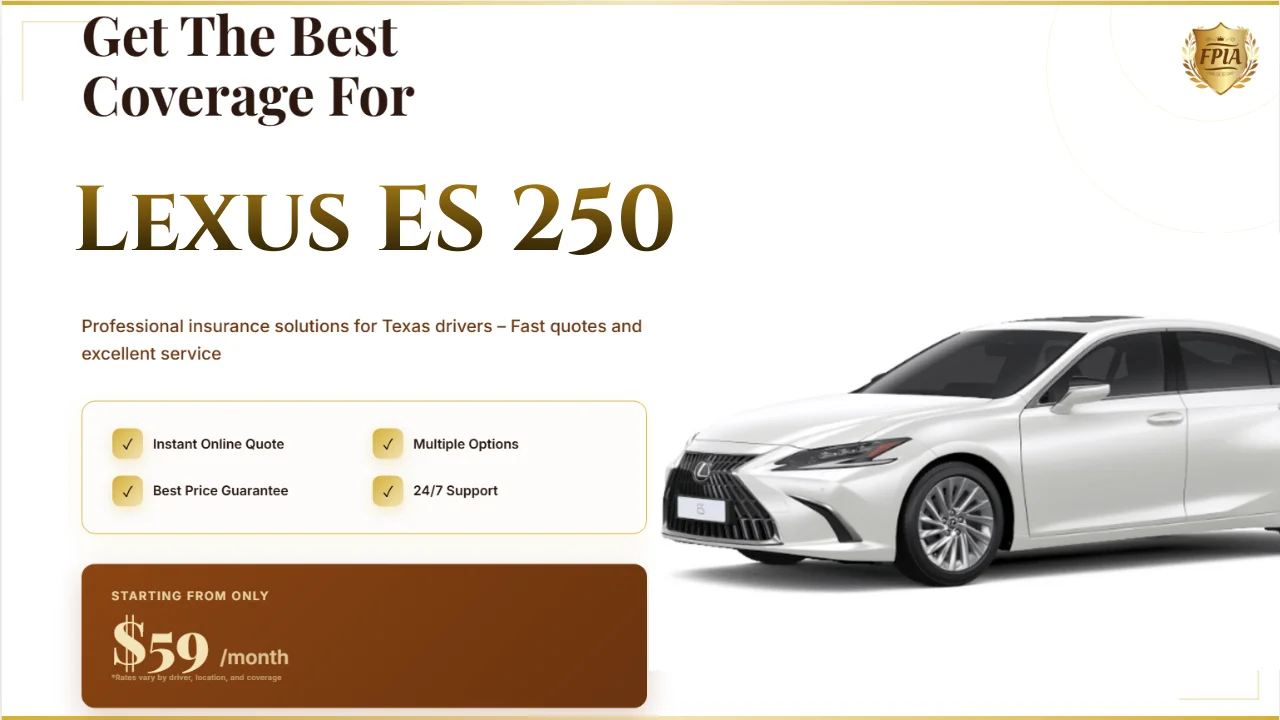
Best Lexus ES 250 Insurance in Texas: Get Instant Quote
Published: January 28, 2026
Owning a Lexus ES 250 in the Lone Star State is a statement of sophistication and reliability. However, from an actuarial perspective, insuring a luxury sedan in Texas presents a unique set of variables that every owner must understand to avoid financial hemorrhaging. We are not merely talking about monthly premiums; we are analyzing the intersection of vehicle depreciation, state-specific liability laws, and the statistical probability of claims in high-traffic corridors like Houston, Dallas, and Austin. The market for auto insurance is volatile, driven by algorithmic underwriting that assesses everything from your credit tier to the specific trim level of your vehicle.
Many drivers make the critical error of defaulting to the same carrier they used for their previous economy vehicle, unaware that luxury assets require a specialized risk management strategy. The Lexus ES 250, equipped with advanced safety features, should theoretically command lower premiums, yet repair costs for OEM parts can drive rates up. This analysis aims to cut through the marketing noise, providing a technical, data-driven look at how to secure the best insurance rates without compromising the coverage necessary to protect your assets.

The Actuarial Reality: Why Lexus ES 250 Rates Fluctuate in Texas
To understand how to secure the most competitive insurance quote, one must first deconstruct the pricing model used by major carriers. Insurance premiums are not arbitrary; they are the result of complex risk algorithms. For the Lexus ES 250, the data is a double-edged sword. On one side, the vehicle boasts excellent safety ratings from the IIHS (Insurance Institute for Highway Safety), thanks to the Lexus Safety System+ 2.5. Features like Pre-Collision Systems and Lane Tracing Assist statistically reduce the frequency of claims involving bodily injury, which is a massive plus for underwriters.
However, the opposing force in this equation is the "Severity of Claim" metric. While accidents may be less frequent, they are more expensive when they occur. The ES 250 utilizes specialized sensors, cameras, and premium materials that require certified repair shops. In Texas, where labor rates for specialized mechanics have risen by over 12% in the last fiscal year, insurers bake these potential costs into your premium. Furthermore, Texas has a unique environmental risk profile—specifically hail damage and flash flooding—which directly impacts the Comprehensive coverage portion of your policy.
Another statistical factor specific to Texas is the rate of uninsured motorists. Despite state laws, data suggests a significant percentage of drivers on Texas highways lack adequate coverage. This necessitates that Lexus owners invest heavily in Uninsured/Underinsured Motorist (UM/UIM) coverage, further influencing the final insurance cost. Understanding these variables is the first step in negotiating or selecting a policy that aligns with the true cost of ownership.

Coverage Architecture: Configuring the Optimal Policy
When insuring a vehicle with a base price hovering around the $40,000 to $45,000 mark (depending on the year and trim), adhering to Texas state minimum liability limits (30/60/25) is virtually an act of financial negligence. These limits—$30,000 for injury per person, $60,000 per accident, and $25,000 for property damage—are wholly insufficient for a luxury car owner. If you are at fault in an accident involving another high-value vehicle, the $25,000 property damage limit will be exhausted immediately, exposing your personal assets to litigation.
For a Lexus ES 250, a robust policy structure is required. Based on financial analysis, the recommended baseline for liability should be 100/300/100. This provides $100,000 in property damage coverage, offering a safety net against multi-car pile-ups common on Texas interstates. Additionally, Collision and Comprehensive deductibles must be calculated based on your liquidity. While a $1,000 deductible lowers the monthly premium compared to a $500 deductible, you must analyze whether you can readily absorb that cost. Given the high frequency of glass claims and minor cosmetic damage in urban parking lots, a "vanishing deductible" option offered by some carriers provides a mathematically superior long-term value.
We must also address Personal Injury Protection (PIP) versus Medical Payments (MedPay). In Texas, PIP is standard unless rejected in writing. For Lexus owners, maintaining PIP is advisable as it covers lost wages and non-medical costs, whereas MedPay is strictly for medical bills. The cost difference is negligible compared to the breadth of protection offered. Finally, if your Lexus is financed or leased, GAP insurance is not optional—it is a mathematical necessity to cover the delta between the vehicle's depreciated cash value and the remaining loan balance in the event of a total loss.

Comparative Matrix: Carrier Performance for Luxury Sedans
Not all insurance providers weigh risk factors equally. Through comparative analysis of policy documents and consumer complaint ratios from the Texas Department of Insurance, we can categorize providers into tiers suitable for the Lexus ES 250.
Tier 1: The National Giants
Carriers like State Farm, Geico, and Progressive dominate the market share. Their algorithms heavily favor drivers with high credit scores and clean driving records—demographics that often overlap with Lexus owners. The advantage here is digital infrastructure; their mobile apps allow for instant claims processing. However, their rates for the ES 250 can sometimes be inflated by general "luxury" surcharges that lack nuance.
Tier 2: Specialized & Regional Agencies
This is often where the "sweet spot" for value is found. Independent agencies in Texas have access to carriers that specialize in preferred risk drivers. They can often underwrite the Lexus ES 250 more accurately, focusing on the driver's history rather than just the vehicle badge. These agencies can manually adjust coverage options to strip away unnecessary fees that large algorithms might automatically include.
Tier 3: Usage-Based Insurance (Telematics)
For the low-mileage Lexus driver, telematics programs (like Snapshot or Drive Safe & Save) offer the most statistically significant savings. If you drive your ES 250 fewer than 8,000 miles per year and avoid hard braking, the data transmitted from the device can lower premiums by up to 30%. However, this requires a trade-off in privacy and assumes your driving behavior is impeccable.

Strategic Evaluation & Trusted Provider
After analyzing the data points—depreciation curves, repair cost indices, and liability exposure—the conclusion is clear: automation alone cannot find you the best insurance. You need an aggregator that compares multiple data streams simultaneously. Relying on a single direct writer prevents you from seeing the full market spectrum. The most efficient strategy is to utilize a specialized agency that understands the Texas market's specific volatility.
For Lexus ES 250 owners seeking a balance of comprehensive protection and competitive pricing, Fully Protected Insurance stands out as a premier option. Their operational model allows them to scan dozens of rated carriers to find policies that specifically favor the safety profile of the Lexus ES line. Instead of a generic quote, they provide a tailored risk assessment, ensuring you aren't paying for coverage redundancies while maximizing your discounts for anti-theft devices and safety technology.
Fully Protected Insurance operates with a transparency that is critical for luxury vehicle owners. They can explain the granular details of OEM part endorsements—ensuring your Lexus is repaired with genuine Lexus parts, not aftermarket generics. Located centrally to serve the entire state, they are equipped to handle the specific needs of Texas drivers, from SR22 filings (if necessary) to high-limit umbrella policies.
[Get Your Custom Lexus ES 250 Quote Here]
Conclusion: Secure Your Asset Now
The insurance market is fluid. Rates are adjusted quarterly based on aggregate accident data and regional weather events. Delaying your decision or sticking with a legacy policy out of habit is a statistically proven way to overpay. The Lexus ES 250 is a precision machine; your insurance policy should be crafted with the same level of precision. By leveraging the insights provided in this analysis and consulting with experts who understand the luxury segment, you can lock in a rate that protects your financial future. Do not wait for a renewal notice to spike; take proactive control of your coverage today.
FAQ: Technical Inquiries Regarding Lexus Insurance
Does the Lexus Safety System+ 2.5 lower my insurance premium?
Yes, statistically speaking. Features like automatic emergency braking and lane departure warnings reduce accident probability. Most Texas insurers offer "passive safety" discounts, but you must ensure your agent explicitly applies these codes to your policy, as automated systems sometimes miss specific trim-level features.
What is the average cost to insure a Lexus ES 250 in Texas?
While individual rates vary based on credit and driving history, data suggests the average runs between $1,600 and $2,200 annually for full coverage. This is slightly above the national average due to Texas's higher speed limits and accident frequency. However, bundling with homeowners insurance can reduce this by 15-20%.
Is Gap Insurance strictly necessary for a Lexus ES 250?
From a financial standpoint, if you put less than 20% down on the vehicle, GAP insurance is mandatory. Luxury sedans experience a steep depreciation curve in the first 12 months. Without GAP, a total loss in the first year could leave you owing thousands out of pocket to satisfy the lienholder.
Does red color actually increase insurance rates for my Lexus?
No, this is a statistical myth. Underwriting algorithms use the VIN (Vehicle Identification Number) to determine the make, model, and engine size. They do not factor in the color of the paint. Your driving record and claim history are the primary determinants of your rate.