



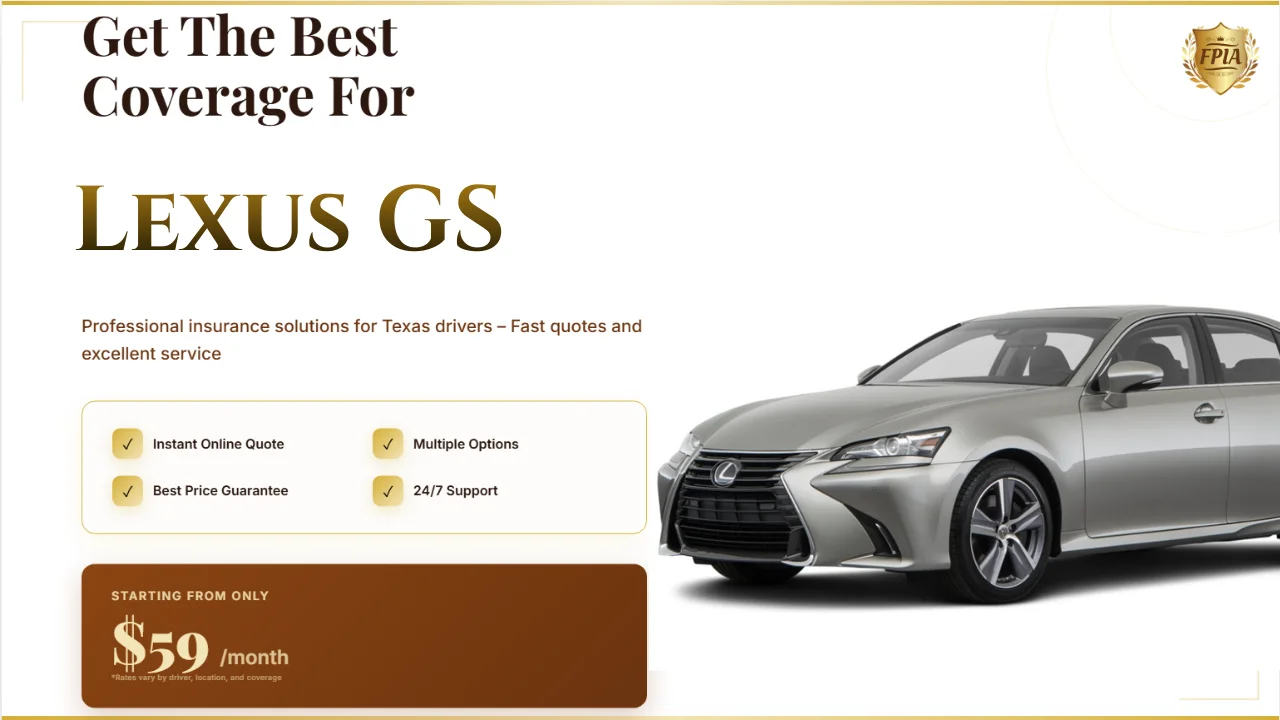
Best Lexus GS Insurance in Texas: Get Instant Quote
Published: January 28, 2026
Owning a Lexus GS in the Lone Star State is a statement of refined taste. It balances the reliability of Japanese engineering with the performance of a legitimate sport sedan. However, when it comes to securing the best Lexus GS insurance in Texas, many owners find themselves navigating a complex matrix of actuarial data, fluctuating premiums, and coverage gaps. From the bustling highways of Houston to the hail-prone regions of North Texas, insuring a discontinued luxury vehicle like the GS requires a strategic approach rather than a generic policy.
As an automotive financial analyst, I have dissected the market trends for 2024 and 2025. The reality is that Texas insurance rates are climbing due to increased population density and weather-related claims. For a vehicle like the Lexus GS 350 or the high-performance GS F, the difference between a standard policy and a specialized quote can amount to hundreds of dollars annually. It is not just about finding the cheapest number; it is about calculating the "Total Cost of Risk" (TCOR). You need a policy that respects the vehicle's residual value while protecting your personal assets from the high liability risks present on Texas roads.
This technical analysis will break down exactly how to structure your policy, which variables are driving up costs for Lexus owners specifically, and how to leverage data to secure the most competitive rates available today.

The Actuarial Reality: Why Lexus GS Insurance Costs Vary in Texas
To understand how to lower your premium, you must first understand how underwriters view the Lexus GS. Unlike a standard economy car, the GS occupies a specific niche in the insurance risk algorithm. It is classified as a luxury mid-size sedan, but certain trims, specifically the F Sport and GS F, push it into the "performance" category, which carries a higher risk coefficient.
1. The "Discontinued" Factor and Parts Availability Since Lexus officially discontinued the GS line in 2020 to focus on the ES and LS models, parts availability has slowly shifted. While mechanical parts remain abundant due to shared platforms with other Toyota/Lexus models, cosmetic and body panels are becoming rarer. In the event of a collision, the cost to repair a GS front bumper or the complex spindle grille is significantly higher than average. Insurers factor this "severity of loss" into your comprehensive and collision premiums.
2. Texas-Specific Risk Variables Texas presents a unique challenge for Lexus GS insurance. The state has one of the highest rates of uninsured drivers in the country. Furthermore, environmental factors play a massive role. The frequency of hail storms in areas like Dallas-Fort Worth and the flood risks in coastal regions mean that "Comprehensive" coverage is not optional—it is a financial necessity. Data shows that luxury sedans are often targets for catalytic converter theft or rim theft in urban centers, further driving up the comprehensive portion of the premium.
3. Safety Ratings vs. Repair Costs The Lexus GS historically boasts excellent safety ratings from the IIHS. While this usually lowers the medical payment (MedPay) and personal injury protection (PIP) portions of your premium, the advanced safety sensors (Lexus Safety System+) located in the bumpers and windshield make minor fender benders expensive to fix. Recalibrating sensors after a windshield replacement adds hundreds to the claim, which is why your premium reflects high technical repair costs.
Optimizing Coverage: The Golden Ratio for Lexus GS Owners
Many Texas drivers make the critical error of defaulting to the state minimums to save money. For a Lexus GS owner, this is a financial trap. Based on asset protection analysis, here is the recommended coverage structure to ensure you are fully protected without overpaying for unnecessary add-ons.
Liability Limits: The 100/300/100 Rule Texas state minimums (30/60/25) are woefully inadequate for a luxury car owner. If you are at fault in an accident involving another high-value vehicle (common in cities like Austin or Plano), a $25,000 property damage limit will be exhausted immediately. We recommend a minimum of 100/300/100 coverage ($100k bodily injury per person, $300k per accident, and $100k property damage). This shields your personal assets from litigation.
Deductible Strategy: The Breakeven Point One of the most effective ways to lower your monthly Lexus insurance rate is by adjusting your deductibles. Statistical analysis suggests that raising your deductible from $500 to $1,000 can reduce your collision and comprehensive premiums by 15% to 25%. If you have a clean driving record, the savings over two years will often exceed the difference in the deductible. For older GS models (2013-2016), consider if you have enough liquidity to cover a $1,000 repair bill instantly; if yes, the premium savings are mathematically superior.
Uninsured/Underinsured Motorist (UM/UIM) In Texas, rejecting this coverage must be done in writing. Do not do it. With the high density of uninsured drivers, your Lexus GS is at risk every time it leaves the garage. UM/UIM coverage ensures that your vehicle is repaired and your medical bills are paid even if the other driver has no insurance or insufficient limits.

Strategic Discounts: How to Lower Your Premium
Insurers use complex algorithms to determine eligibility for discounts. As a consumer, you need to proactively ensure these are applied to your policy. Here are the specific areas where Lexus GS owners can maximize savings.
1. Telematics and Usage-Based Insurance (UBI)
If you are a safe driver, you are likely subsidizing the bad habits of others. Most major carriers in Texas now offer UBI programs that track your driving via a mobile app or a plug-in device. They monitor hard braking, rapid acceleration, and time of day. Given that the Lexus GS is a driver’s car, you might be tempted to drive aggressively, but if you use the vehicle primarily for commuting, enabling this feature can yield discounts of up to 30%. This is pure data-driven savings.
2. Advanced Safety Features
The Lexus GS is equipped with anti-theft devices, daytime running lights, blind-spot monitoring, and lane departure warnings. Verify that your agent has coded these correctly in the system. Often, the VIN decoder picks up the model but misses specific optional safety packages installed on your trim level. Manually verifying these safety features can trigger "passive restraint" and "anti-theft" discounts.
3. The Multi-Line Bundle
The mathematics of bundling are undeniable. combining your Texas auto insurance with homeowners or renters insurance is the single largest discount available, often ranging from 15% to 20%. For Lexus owners who also own property, keeping these policies under one roof simplifies claims and drastically reduces the overhead cost per policy.

Market Evaluation & Recommended Provider
After analyzing the competitive landscape in Texas, it becomes clear that "big box" national carriers often treat the Lexus GS as a generic high-risk sports sedan. They rely on broad zip-code-based algorithms that may not reflect your specific driving history or the safety profile of the vehicle accurately. Conversely, independent agencies have the ability to shop your profile across multiple underwriters to find the "sweet spot" where your risk profile matches a carrier's appetite.
For Texas drivers, specifically those owning premium vehicles like the Lexus GS, working with a specialized agency is critical. You need an agent who understands the nuance between a GS 350 F Sport and a standard GS 350. This distinction alone can alter the premium class. Furthermore, local agents are better equipped to handle Texas-specific claims, such as flood damage from tropical storms or hail damage, ensuring your OEM parts rider is honored.
We have identified Fully Protected Insurance as a top-tier provider for this segment. Their approach combines modern quoting technology with personalized risk assessment, ensuring you aren't paying for coverage you don't need while maximizing protection where it counts.
[Get Your Instant Lexus GS Quote Here]
Final Verdict: Secure Your Rate Now
The insurance market is volatile. Rates are adjusted frequently based on aggregate loss data in your zip code. Waiting to renew or shopping around only when your policy expires is a passive strategy that costs money. The data suggests that proactive quoting—checking rates every 6 to 12 months—is the only way to stay ahead of inflation and rate hikes.
Your Lexus GS deserves protection that matches its quality. Do not let a generic algorithm dictate your financial exposure. By adjusting your liability limits, optimizing your deductibles, and leveraging a broker who understands the Texas market, you can secure a rate that makes sense for your budget and your vehicle. Take action today, review your current declaration page, and compare it against a new quote.
FAQ: Common Questions About Lexus GS Insurance in Texas
Is the Lexus GS considered a sports car for insurance purposes?
It depends on the trim and the carrier. The standard GS 350 is typically classified as a luxury sedan. However, the GS F with the V8 engine is almost universally classified as a high-performance sports car, which attracts higher premiums. The F Sport trim falls somewhere in the middle; some insurers rate it higher due to the badge, while others see it merely as a cosmetic package.
How does the discontinuation of the Lexus GS affect my insurance rates?
Generally, discontinued cars do not see immediate rate spikes. However, as time passes (5+ years post-production), if parts become scarce or expensive to source, collision premiums may rise. Currently, in 2024-2025, parts are still readily available, so the impact is minimal. The main driver of cost is the luxury classification and repair labor rates, not the discontinuation status.
What is the most important coverage for a Lexus GS in Texas?
Comprehensive coverage is arguably the most critical variable for Texas drivers due to non-collision events. Texas leads the nation in hail damage claims, and flood risks are significant in metro areas. Additionally, Uninsured Motorist Property Damage (UMPD) is vital because it protects your vehicle if you are hit by a driver with no insurance, which is a statistical probability in Texas cities.
Can I use OEM parts for repairs on my Lexus GS?
Most standard policies default to "Aftermarket" or "Like Kind and Quality" (LKQ) parts to save costs. If you want genuine Lexus parts used in repairs, you must specifically request an OEM Parts Endorsement on your policy. This will increase your premium slightly, but for a luxury vehicle like the GS, it ensures proper fitment and maintains the resale value.