



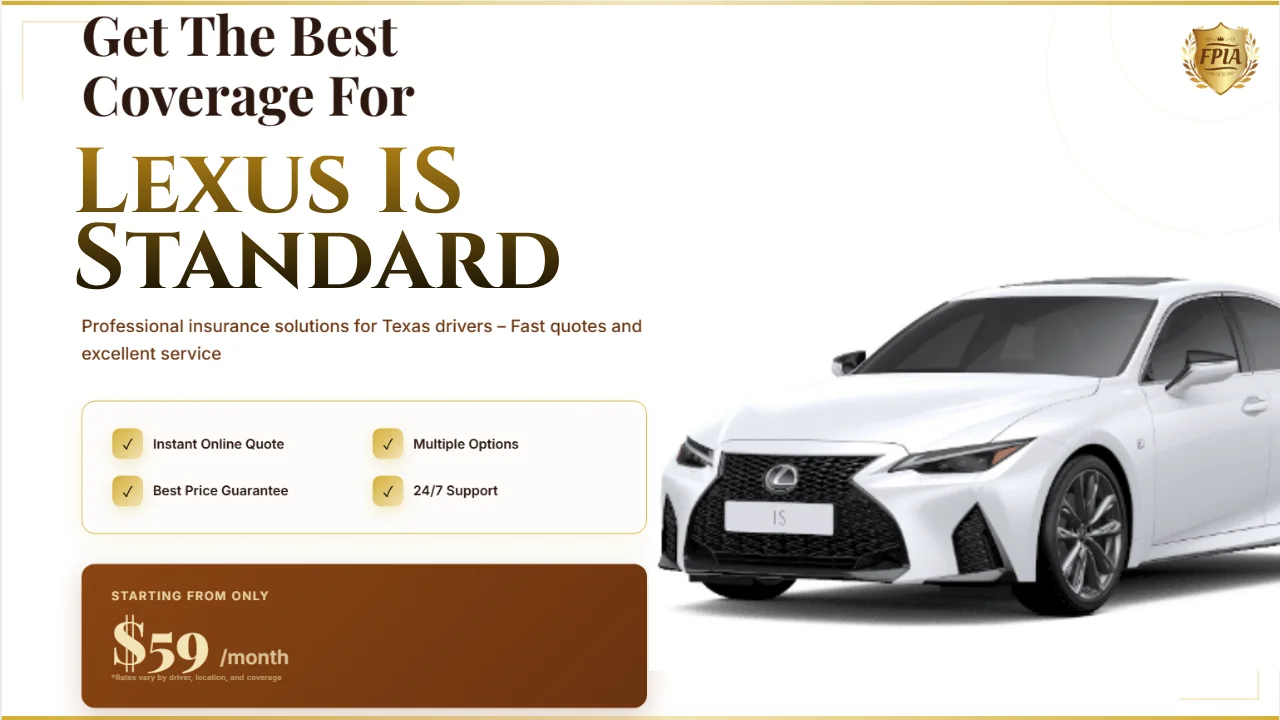
Best Lexus IS Standard Insurance in Texas: Get Instant Quote
Published: January 28, 2026
When it comes to insuring a luxury sport sedan like the Lexus IS in Texas, relying on guesswork or generic quotes is a financial error that can cost you thousands of dollars annually. As an insurance market analyst, I have observed a distinct trend: Texas drivers often underestimate the complexity of insuring high-performance vehicles, leading to either dangerous gaps in coverage or significantly overpaying for premiums. The Lexus IS, known for its reliability and resale value, occupies a unique segment in the auto insurance algorithm. It is not classified as a high-risk exotic car, yet its repair costs and technology suite place it well above standard economy sedans.
In the Lone Star State, where insurance rates have seen a steady incline due to population density, weather events, and litigation trends, finding the Best Lexus IS Standard Insurance requires a data-driven approach. You cannot simply accept the first number you see on a comparison site. You must understand how underwriters view your vehicle, your zip code, and your driving profile. This analysis will strip away the marketing fluff and focus strictly on the numbers, the coverage necessities, and the technical specifications that influence your final premium. We will dissect the factors that make Texas a unique market for Lexus owners and provide a calculated pathway to securing a policy that balances comprehensive protection with fiscal responsibility.
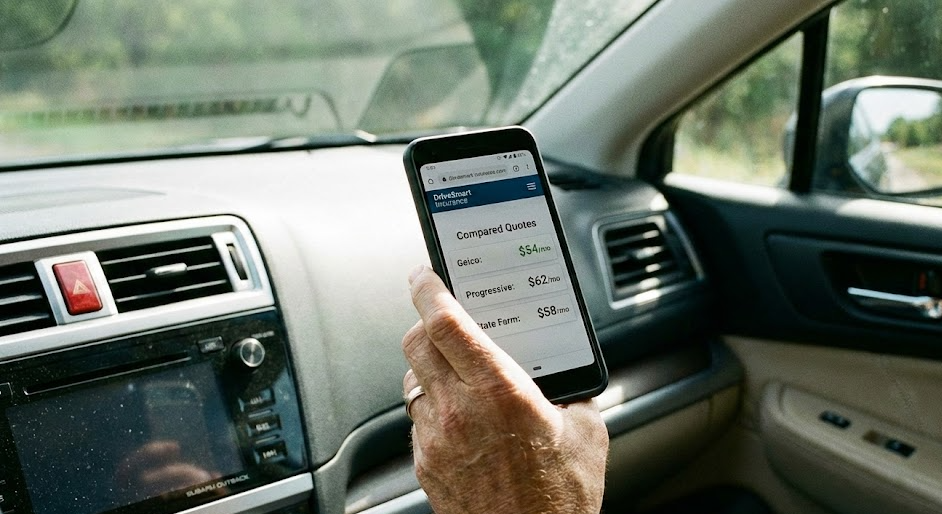
Technical Analysis: Why the Lexus IS Has a Unique Risk Profile
To secure the best rates, you must first understand the asset you are protecting. From an actuarial perspective, the Lexus IS is a fascinating case study. Unlike European competitors which often suffer from exorbitant depreciation and specialized labor costs, the Lexus IS benefits from the Toyota supply chain, generally keeping mechanical repair costs reasonable. However, "reasonable" in the luxury segment is still significantly higher than the average market standard.
The primary factor driving premiums for the Lexus IS is the integration of advanced safety technology. The Lexus Safety System+ includes pre-collision systems, lane tracing assist, and radar cruise control. While these features statistically reduce the frequency of accidents—a factor that lowers your liability rating—they drastically increase the severity of a claim when an accident does occur. A minor fender bender that would cost $500 to repair on a ten-year-old sedan can easily exceed $3,000 on a Lexus IS due to the calibration required for sensors housed within the bumpers and grille.
Furthermore, we must analyze the theft statistics. In Texas urban centers like Houston and Dallas, luxury sedans are frequent targets. While the Lexus IS is not the most stolen vehicle in the state, its parts are in high demand. Insurance carriers factor this comprehensive risk into your premium. Therefore, when looking for standard insurance, you are not just paying for your driving ability; you are paying for the likelihood of the vehicle being targeted and the technical cost of restoring it to factory specifications.

The Mathematics of Coverage: State Minimums vs. Financial Reality
Texas law requires every driver to carry evidence of financial responsibility. The current state minimums are defined as 30/60/25. This translates to $30,000 for bodily injury per person, $60,000 for bodily injury per accident, and $25,000 for property damage. For a Lexus IS owner, adhering strictly to these standard insurance minimums is a mathematically unsound strategy.
Let us analyze the property damage limit of $25,000. If you are at fault in an accident involving another luxury vehicle or a modern full-size pickup truck—which are ubiquitous in Texas—$25,000 will likely be exhausted immediately. Once your insurance limit is breached, your personal assets become the target of litigation. For a demographic that owns Lexus vehicles, this asset exposure is an unacceptable risk. A technical analysis of average claim costs in Texas suggests that limits of 100/300/100 should be the absolute baseline for this vehicle class.
Additionally, we must discuss Uninsured/Underinsured Motorist (UM/UIM) coverage. Statistics from the Texas Department of Motor Vehicles indicate a significant percentage of drivers on Texas roads are uninsured. If you are hit by one of these drivers, your Lexus IS standard insurance policy needs to step in. Without UM/UIM, you are essentially self-insuring against the negligence of others, relying solely on your own health insurance and funds to repair your vehicle. Given the repair costs mentioned in the previous section, skipping this coverage to save $10 a month is statistically unwise.
Variables Affecting Your Premium Algorithm in Texas
Insurance carriers utilize complex proprietary algorithms to determine your rate. Understanding these variables allows you to manipulate them—legally—to your advantage. Here is a breakdown of the high-impact data points for Texas drivers:
- Credit-Based Insurance Scores: Texas allows insurers to use credit history as a rating factor. Data shows a strong correlation between credit stability and claim frequency. A higher credit score can lower your premium on a Lexus IS by as much as 20%.
- Garaging Zip Code: Texas is vast, and risk is geographic. Insuring a Lexus IS in Harris County (prone to flooding and high traffic density) will statistically cost more than insuring the same vehicle in a rural county. This is due to the "comprehensive" risk factors like hail, flood, and theft.
- Annual Mileage: The more you drive, the higher your exposure to risk. If you work from home or have a short commute, ensuring your policy reflects an annual mileage of under 7,500 can trigger a low-mileage discount bracket.
- Prior Insurance History: A lapse in coverage is a red flag for algorithms. Maintaining continuous coverage, even when you do not own a car for a brief period (via a non-owner policy), keeps you in the "preferred" tier rather than the "standard" or "high-risk" tier.

Expert Evaluation: Identifying High-Value Providers
When evaluating providers for the Best Lexus IS Standard Insurance in Texas, we move beyond the television commercials and look at the financial stability and claims satisfaction ratings (loss ratios). You need a carrier that understands the luxury market but operates with the efficiency of a volume provider.
Large national carriers often provide stability, but they may lack the localized flexibility required for the Texas market. Conversely, local independent agencies can shop your profile across multiple carriers—including Progressive, Travelers, and Safeco—to find the specific underwriter that favors the Lexus demographic this quarter. The "sweet spot" for a Lexus IS owner is often a bundled policy (Home/Auto or Renters/Auto) which locks in multi-line discounts.
Based on current market data, agencies that specialize in "standard" and "preferred" markets are offering the most competitive rates for the Lexus IS. They are able to apply discretionary credits for safety features that generic online quote generators often miss. For example, verifying that your specific VIN carries the anti-theft package can drop your comprehensive deductible costs significantly. We strongly recommend utilizing a specialized agency that can manually review the quote for these missing credits.
[Get Your Instant Lexus IS Quote Here]
Action Plan: Securing Your Policy Efficiently
To conclude this analysis, the path to securing the best insurance for your Lexus IS is procedural. Do not approach this emotionally; approach it mathematically. Gather your VIN, your current declaration page (to match limits), and your exact mileage usage. When you request a quote, specifically ask for a breakdown of how the safety features of your Lexus are being factored into the premium.
Avoid the "state minimum" trap. It is a false economy that exposes you to catastrophic financial loss. Instead, opt for higher liability limits and raise your deductibles (e.g., from $500 to $1,000) to offset the premium cost. This shifts the risk of small, manageable expenses to you, while transferring the risk of catastrophic loss to the insurer—which is the fundamental purpose of insurance. By following this technical framework, you will secure a policy that is both robust and economically efficient.

FAQ: Common Technical Inquiries Regarding Lexus Insurance
Does the color of my Lexus IS affect the insurance premium?
No, this is a pervasive myth. Insurance algorithms focus on the Vehicle Identification Number (VIN), engine size, safety rating, and theft statistics. The color of the paint does not technically correlate with accident frequency in the eyes of underwriters.
Is GAP insurance necessary for a Lexus IS?
From a financial standpoint, yes, if you put down less than 20% at the time of purchase. Luxury vehicles depreciate, and if your vehicle is totaled in the first two years, the actual cash value (ACV) payout from the insurer may be less than the loan balance. GAP coverage bridges this financial delta.
How does a speeding ticket affect my Lexus IS rates in Texas?
A moving violation in Texas generally remains on your record for three years. Data suggests a single speeding ticket can raise premiums by 15-25% for high-performance sedans, as it alters the driver's risk profile from "preferred" to "standard." Defensive driving courses can sometimes mitigate this surcharge.
Why is my renewal rate increasing even though I had no claims?
This is likely due to a statewide "rate revision." Insurance companies adjust base rates across the board based on the aggregate loss data in your zip code (e.g., increased hail storms or a spike in local auto thefts). It is an external market factor, not a penalty for your specific driving behavior.